
Floral Absolutes vs Essential Oils: What’s the Difference?
The global fragrance, aromatherapy, cosmetic, and wellness industries rely heavily on plant-derived aromatic ingredients. Among the most popular are essential oils and floral absolutes. While both originate from botanical sources and are valued for their unique aromas, they differ significantly in extraction methods, composition, applications, cost, and market demand.
Many buyers, cosmetic formulators, perfumers, and wellness brands often ask: Are floral absolutes the same as essential oils? The simple answer is no. Although they share certain similarities, floral absolutes and essential oils serve different purposes and are produced using different techniques.
At Premium Essential Oils, we supply premium-quality essential oils and floral absolutes for global manufacturers, wellness brands, aromatherapy companies, and cosmetic formulators. This guide explains the key differences between floral absolutes and essential oils while helping buyers choose the right ingredient for their products.
What Are Essential Oils?
Essential oils are highly concentrated aromatic compounds extracted from various parts of plants, including leaves, flowers, roots, bark, seeds, and fruits. These oils capture the natural fragrance and chemical profile of the plant.
Common extraction methods include:
- Steam distillation
- Cold pressing
- Hydro-distillation
- CO₂ extraction
Popular essential oils include:
- Lavender Oil
- Peppermint Oil
- Tea Tree Oil
- Eucalyptus Oil
- Lemongrass Oil
- Rosemary Oil
Learn more in our guide: Top 10 Most Popular Essential Oils and Their Uses
What Are Floral Absolutes?
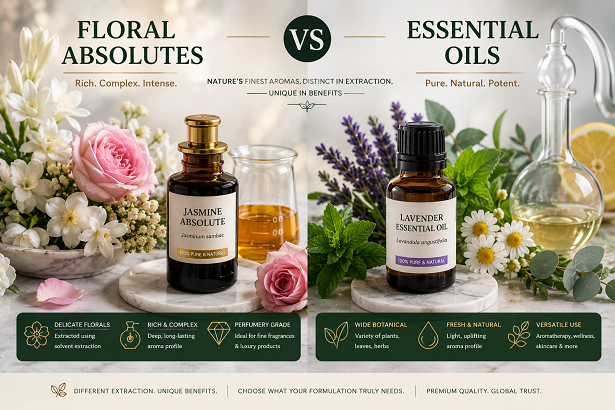
Floral absolutes are highly aromatic extracts obtained primarily from delicate flowers that cannot tolerate traditional steam distillation. Many flowers contain fragile aromatic molecules that may be damaged by heat.
To preserve these delicate fragrances, manufacturers use solvent extraction methods that capture a broader range of aromatic compounds.
Popular floral absolutes include:
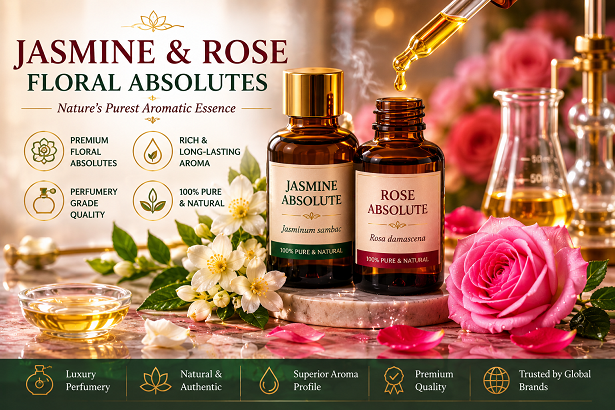
- Jasmine Absolute
- Rose Absolute
- Tuberose Absolute
- Champaca Absolute
- Mimosa Absolute
- Osmanthus Absolute
Explore our collection: Floral Absolutes
How Are Floral Absolutes Different from Essential Oils?
| Factor | Essential Oils | Floral Absolutes |
|---|---|---|
| Extraction Method | Steam distillation or cold pressing | Solvent extraction |
| Aroma Profile | Lighter and fresher | Richer and more complex |
| Heat Sensitivity | Suitable for many botanicals | Ideal for delicate flowers |
| Cost | Generally lower | Usually higher |
| Perfumery Use | Moderate | Extensive |
| Production Yield | Higher | Lower |
Why Are Floral Absolutes More Expensive?
Floral absolutes are often significantly more expensive than essential oils because:
- Large quantities of flowers are required
- Extraction yields are very low
- Harvesting is labor-intensive
- Delicate flowers require careful processing
- Production involves multiple extraction stages
For example, thousands of jasmine blossoms may be needed to produce a small quantity of jasmine absolute.
Which Products Use Essential Oils?
Essential oils are widely used in:
- Aromatherapy products
- Massage oils
- Skincare formulations
- Hair care products
- Natural cleaning products
- Wellness products
- Gaming lifestyle relaxation products
Their versatility makes them one of the most commercially important botanical ingredients worldwide.
Which Products Use Floral Absolutes?
Floral absolutes are especially valued in luxury fragrance and premium cosmetic applications.
Common uses include:
- Fine perfumery
- Luxury skincare
- Premium cosmetics
- Natural fragrances
- Personal care products
- Aromatherapy blends
Their rich aroma profile provides depth and complexity that many synthetic fragrances cannot replicate.
Which Is Better: Floral Absolutes or Essential Oils?
Neither is universally better. The ideal choice depends on product goals.
| Application | Recommended Option |
|---|---|
| Aromatherapy | Essential Oils |
| Luxury Perfumes | Floral Absolutes |
| Mass Market Cosmetics | Essential Oils |
| Premium Fragrances | Floral Absolutes |
| Wellness Products | Essential Oils |
| Luxury Skincare | Both |
Why Is Global Demand for Floral Absolutes Growing?
Several market trends are increasing demand:
- Clean beauty movement
- Natural fragrance preference
- Luxury skincare growth
- Premium perfume demand
- Sustainable ingredient sourcing
Consumers increasingly seek authentic botanical ingredients, creating new opportunities for floral absolutes worldwide.
How Does Quality Affect Floral Absolutes and Essential Oils?
Quality remains one of the most important purchasing factors.
Professional manufacturers perform:
- GC/MS testing
- Purity verification
- Batch consistency checks
- Microbial testing
- Export compliance testing
Learn more: Quality Standards in Essential Oil Manufacturing Explained
Why Is India Important in Floral Absolute Manufacturing?
India is one of the leading producers of floral absolutes due to:
- Rich botanical diversity
- Large-scale flower cultivation
- Traditional extraction expertise
- Competitive manufacturing costs
- Strong export infrastructure
Read more: Why India is a Global Hub for Essential Oil Manufacturing
Sources and References
Conclusion
Floral absolutes and essential oils are both valuable botanical ingredients, but they differ significantly in extraction methods, aroma profiles, applications, and market positioning.
Essential oils dominate aromatherapy, wellness, and personal care markets, while floral absolutes remain the preferred choice for luxury perfumery and premium cosmetic formulations.
Understanding these differences helps buyers, formulators, and brands select the most suitable ingredient for their specific product goals.
Frequently Asked Questions
1. Are floral absolutes the same as essential oils?
No. Floral absolutes are produced through solvent extraction, while essential oils are generally extracted using steam distillation or cold pressing.
2. Why are floral absolutes more expensive?
They require large quantities of flowers, complex extraction processes, and produce lower yields.
3. Which flowers are commonly used for absolutes?
Jasmine, rose, tuberose, mimosa, champaca, and osmanthus are among the most popular.
4. Are floral absolutes used in perfumes?
Yes. Floral absolutes are widely used in luxury and niche perfumery because of their rich aroma profiles.
5. Can floral absolutes be used in skincare products?
Yes. They are often included in premium skincare and cosmetic formulations.
6. How can buyers verify quality?
Buyers should request GC/MS reports, purity certificates, and quality assurance documentation.
If you want expert help, contact us we will guide you.
About the Author
Premium Essential Oils Editorial Team
The Premium Essential Oils editorial team specializes in essential oils, floral absolutes, botanical extracts, export standards, and quality assurance systems. Our content is based on industry expertise and current global market trends to help businesses make informed sourcing decisions.