
Carrier Oils vs Essential Oils: Key Differences Explained
Natural botanical oils have become an integral part of the cosmetics, aromatherapy, pharmaceutical, wellness, and personal care industries. Among the most widely used plant-derived oils are essential oils and carrier oils. Although these two categories are often mentioned together, they differ significantly in their source, extraction method, chemical composition, applications, and safety considerations.
For manufacturers, wholesalers, formulators, importers, and consumers, understanding these differences is essential when selecting the right ingredients for skincare, hair care, massage blends, cosmetics, soaps, perfumes, and wellness products. Choosing the correct oil improves product performance, ensures user safety, and supports regulatory compliance in international markets.
At Premium Essential Oils, we manufacture and export a comprehensive range of premium-quality Essential Oils, Carrier Oils, Floral Absolutes, Spice Oils, Hydrosols, and USDA Organic Oils for customers across the globe. This guide explains the key differences between carrier oils and essential oils, helping buyers make informed sourcing decisions while understanding current industry best practices.
What Are Essential Oils?
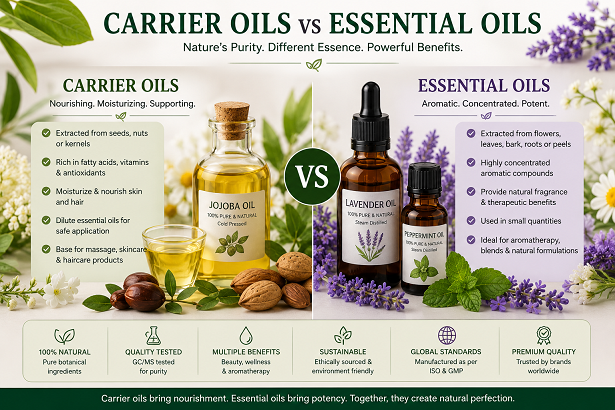
Essential oils are highly concentrated aromatic extracts obtained from various parts of plants, including flowers, leaves, bark, roots, seeds, fruit peels, and wood. These oils contain naturally occurring volatile compounds responsible for the plant's characteristic fragrance and many of its beneficial properties.
Most essential oils are extracted through steam distillation, while citrus oils are commonly obtained by cold pressing. Because they are highly concentrated, only small quantities are typically required in formulations.
Popular examples include:
- Peppermint Essential Oil
- Lavender Essential Oil
- Tea Tree Essential Oil
- Eucalyptus Essential Oil
- Lemon Essential Oil
- Rosemary Essential Oil
- Frankincense Essential Oil
- Orange Essential Oil
These oils are widely used in:
- Aromatherapy
- Cosmetic formulations
- Personal care products
- Home fragrance products
- Soap manufacturing
- Candles
- Massage blends
- Pharmaceutical applications
Because of their high concentration, essential oils are generally diluted before topical application using an appropriate carrier oil.
You may also find our guide useful: Top 10 Most Popular Essential Oils and Their Uses .
What Are Carrier Oils?
Carrier oils are vegetable-based fixed oils extracted primarily from seeds, kernels, nuts, or fruits. Unlike essential oils, carrier oils contain very little or no volatile aroma compounds. Their primary role is to dilute essential oils while providing their own nutritional and moisturizing benefits for skin and hair.
Carrier oils are generally extracted using cold pressing or expeller pressing methods, which help preserve naturally occurring fatty acids, vitamins, antioxidants, and plant nutrients.
Common carrier oils include:
- Jojoba Oil
- Sweet Almond Oil
- Argan Oil
- Coconut Oil
- Avocado Oil
- Grapeseed Oil
- Olive Oil
- Castor Oil
- Sunflower Oil
- Apricot Kernel Oil
Carrier oils are widely used in:
- Facial serums
- Hair oils
- Massage oils
- Moisturizers
- Body lotions
- Cosmetic manufacturing
- Natural skincare products
- Baby care products
Unlike essential oils, many carrier oils can be applied directly to the skin without dilution, although individual sensitivity testing is always recommended.
For a deeper understanding of carrier oils, read our detailed article: Best Carrier Oils for Skin and Hair Care Products .
Carrier Oils vs Essential Oils: Quick Comparison
| Feature | Essential Oils | Carrier Oils |
|---|---|---|
| Source | Flowers, leaves, bark, roots, peels | Seeds, nuts, kernels, fruits |
| Extraction | Steam Distillation / Cold Press | Cold Pressed / Expeller Pressed |
| Aroma | Highly aromatic | Mild or nearly odorless |
| Concentration | Very high | Low |
| Direct Skin Use | Usually No | Usually Yes |
| Main Function | Fragrance & active botanical compounds | Dilution & nourishment |
Why Are Carrier Oils and Essential Oils Used Together?
One of the most common questions among formulators, skincare brands, aromatherapists, and first-time buyers is why carrier oils and essential oils are frequently blended instead of being used individually. The answer lies in their complementary properties. Essential oils are extremely concentrated and contain volatile aromatic compounds that can be too strong for direct application on the skin. Carrier oils help dilute these concentrated extracts while improving spreadability, absorption, and skin compatibility.
A properly formulated blend allows manufacturers to combine the aromatic and functional characteristics of essential oils with the moisturizing and nourishing properties of carrier oils. This approach not only enhances user safety but also improves product performance in cosmetics, massage oils, facial serums, hair oils, soaps, body lotions, and wellness products.
For example, peppermint essential oil is often blended with sweet almond oil or jojoba oil for massage products, while lavender essential oil is commonly combined with grapeseed oil for skincare formulations. These combinations help deliver botanical benefits while reducing the likelihood of skin irritation caused by highly concentrated essential oils.
How Are Carrier Oils and Essential Oils Manufactured?
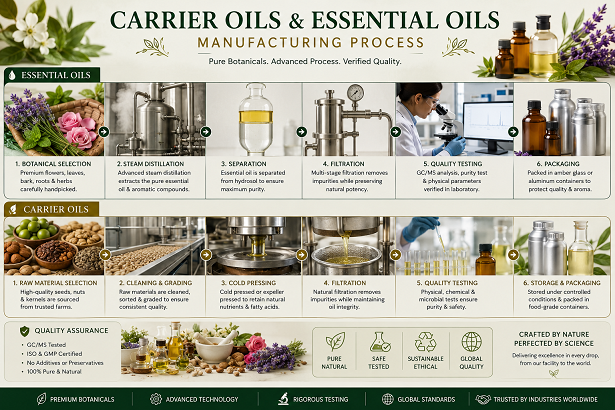
The manufacturing process differs considerably because these oils contain different natural compounds.
Essential Oil Manufacturing
- Selection of fresh botanical raw materials
- Cleaning and grading
- Steam distillation or cold pressing
- Separation of essential oil from hydrosol
- Filtration
- Laboratory testing (GC/MS, purity analysis)
- Packaging in export-grade containers
Since essential oils contain volatile aromatic molecules, maintaining temperature control throughout processing is extremely important. Manufacturers also perform quality testing to verify botanical identity and ensure batch consistency before export.
Read more: Quality Standards in Essential Oil Manufacturing Explained .
Carrier Oil Manufacturing
- Cleaning premium seeds or nuts
- Cold pressing or expeller pressing
- Natural filtration
- Quality testing
- Storage under controlled conditions
- Export packaging
Unlike essential oils, carrier oils retain naturally occurring fatty acids, vitamins, and antioxidants that provide nutritional benefits for skin and hair care formulations.
What Are the Major Differences Between Carrier Oils and Essential Oils?
Although both originate from plants, their physical properties, chemical composition, applications, and commercial uses differ significantly.
| Characteristic | Essential Oils | Carrier Oils |
|---|---|---|
| Texture | Light and volatile | Rich and moisturizing |
| Evaporation | Evaporates quickly | Remains on the skin longer |
| Chemical Composition | Volatile aromatic compounds | Fatty acids, vitamins, antioxidants |
| Primary Purpose | Aroma and active botanical compounds | Moisturizing, dilution, nourishment |
| Typical Usage Rate | Very small percentage | Major ingredient in formulations |
| Shelf Life | Generally 2–5 years | Varies depending on fatty acid profile |
Which Industries Use Carrier Oils and Essential Oils?
Demand for both categories continues to grow because they serve different functions across numerous industries.
Industries Using Essential Oils
- Cosmetics
- Aromatherapy
- Personal care
- Soap manufacturing
- Candles
- Perfumery
- Pharmaceutical formulations
- Home fragrance products
Industries Using Carrier Oils
- Hair care manufacturing
- Skin care products
- Massage oils
- Body lotions
- Natural cosmetics
- Baby care formulations
- Herbal wellness products
- Spa products
Many premium formulations combine both oil categories to create balanced, effective products that meet consumer expectations for natural ingredients and high-quality performance.
Which Oil Should You Choose for Your Product?
Selecting between a carrier oil and an essential oil depends entirely on your product objectives, target market, formulation requirements, and intended application. These oils are not competitors—they serve different yet complementary functions in product development.
If your goal is to add aroma, botanical activity, or natural fragrance, essential oils are the preferred choice. If your objective is moisturizing, conditioning, improving texture, or diluting concentrated botanical extracts, carrier oils become indispensable.
Many premium cosmetic and wellness brands successfully combine both to create high-performance formulations. For example, a facial serum may use jojoba oil as the primary carrier while incorporating small quantities of lavender and tea tree essential oils for their aromatic and botanical properties.
| Application | Recommended Oil |
|---|---|
| Massage Oils | Carrier Oil + Essential Oil Blend |
| Facial Serum | Carrier Oil Base with Essential Oils |
| Hair Oil | Carrier Oil with Botanical Essential Oils |
| Soap Manufacturing | Combination of Both |
| Aromatherapy Diffuser | Essential Oils Only |
| Body Lotion | Mainly Carrier Oils with Small Essential Oil Percentage |
How Can Buyers Select a Reliable Supplier?
Whether sourcing carrier oils or essential oils in bulk, choosing a reliable manufacturer is one of the most important decisions for importers and private-label brands. Consistent quality, transparent documentation, and export expertise directly influence product performance and customer satisfaction.
Before placing a bulk order, buyers should evaluate suppliers based on:
- Years of manufacturing experience
- Quality management systems
- GC/MS testing for essential oils
- Certificates of Analysis (COA)
- Cold-pressed or steam-distilled processing methods
- Batch-to-batch consistency
- Private label and OEM capabilities
- Export documentation support
- Packaging options
- International shipping experience
For more guidance, read: How to Choose the Best Essential Oil Supplier for Bulk Orders.
Why Premium Quality Matters in Global Markets
International buyers increasingly prioritize quality over price. Cosmetic brands, wellness companies, aromatherapy manufacturers, and pharmaceutical formulators expect oils that meet strict international quality standards. Reliable suppliers invest in premium raw materials, advanced extraction technologies, laboratory testing, hygienic production facilities, and export-grade packaging.
At Premium Essential Oils, every batch is produced under carefully controlled conditions to ensure purity, consistency, and compliance with international buyer expectations. Our portfolio includes essential oils, carrier oils, spice oils, hydrosols, floral absolutes, and USDA Organic oils suitable for global markets.
Sources & References
Conclusion
Understanding the difference between carrier oils and essential oils is fundamental for manufacturers, exporters, cosmetic brands, formulators, and international buyers. While essential oils provide concentrated aromatic and botanical compounds, carrier oils deliver nourishment, stability, and safe application. Together, they form the foundation of countless skincare, hair care, wellness, aromatherapy, and cosmetic products.
As demand for natural ingredients continues to grow worldwide, selecting high-quality oils from experienced manufacturers becomes increasingly important. Buyers who prioritize quality assurance, laboratory testing, traceability, and reliable export capabilities can build stronger product portfolios and long-term business partnerships.
Frequently Asked Questions
1. What is the main difference between carrier oils and essential oils?
Essential oils are concentrated aromatic extracts obtained from plants, while carrier oils are fixed vegetable oils used to dilute essential oils and nourish the skin and hair.
2. Can essential oils be applied directly to the skin?
Most essential oils should be diluted with a suitable carrier oil before topical application because they are highly concentrated.
3. Which carrier oils are most popular?
Jojoba oil, sweet almond oil, coconut oil, grapeseed oil, argan oil, avocado oil, and sunflower oil are among the most widely used carrier oils worldwide.
4. Are carrier oils fragrance-free?
Most carrier oils have a mild natural aroma and do not possess the strong fragrance associated with essential oils.
5. Why are carrier oils used in cosmetics?
Carrier oils moisturize the skin, improve product texture, dilute essential oils, and provide beneficial fatty acids, vitamins, and antioxidants.
6. How do buyers identify premium-quality oils?
Buyers should evaluate suppliers based on laboratory testing, Certificates of Analysis, manufacturing standards, certifications, traceability, packaging quality, and export experience.
If you want expert help, contact us we will guide you.
About the Author
Premium Essential Oils Editorial Team
The Premium Essential Oils Editorial Team comprises specialists in botanical extraction, essential oil manufacturing, carrier oil processing, quality assurance, international trade, and private label production. Every article is created using industry expertise and current global best practices to provide accurate, trustworthy, and practical information for manufacturers, wholesalers, importers, formulators, and wellness brands.