
What Are the Export Standards for Peppermint Essential Oil?
Peppermint essential oil is one of the most widely traded botanical oils in the international market due to its refreshing aroma, high menthol content, and broad applications across pharmaceutical, food, cosmetics, aromatherapy, oral care, and personal care industries. As global demand continues to increase, buyers are placing greater emphasis on quality assurance, purity, traceability, documentation, and compliance with international export standards.
For manufacturers and exporters, understanding these standards is essential to building long-term business relationships and meeting buyer expectations. Export-quality peppermint essential oil is more than simply producing a high-quality product—it requires compliance with internationally accepted manufacturing practices, laboratory testing, proper packaging, accurate documentation, and regulatory requirements.
At Premium Essential Oils, we manufacture and export premium-quality peppermint essential oil to customers worldwide while following strict quality management procedures. In this guide, we explain the most important export standards, certifications, documentation requirements, laboratory tests, and quality parameters that international buyers expect.
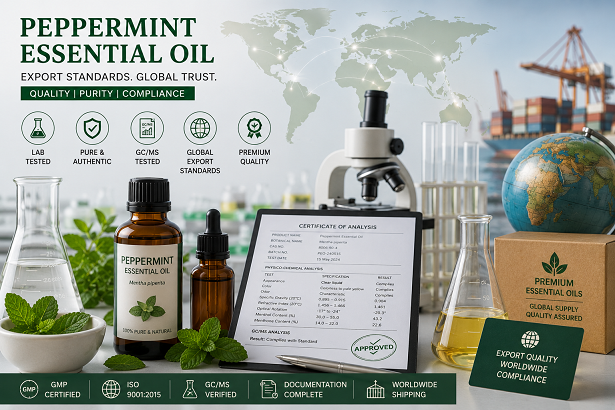
Why Are Export Standards Important for Peppermint Essential Oil?
International buyers require assurance that every shipment meets predefined quality, purity, and safety standards. Export standards reduce the risk of contamination, adulteration, inconsistent quality, and regulatory issues while improving customer confidence.
Following export standards also benefits manufacturers by:
- Improving global credibility
- Reducing shipment rejection risks
- Meeting customs requirements
- Building long-term buyer relationships
- Ensuring product consistency
- Supporting premium pricing
- Increasing repeat export orders
Today's international buyers increasingly perform supplier audits before placing long-term contracts, making documented quality systems more important than ever.
Which International Standards Should Peppermint Essential Oil Meet?
Although specific requirements vary by country and customer, most global buyers expect peppermint oil manufacturers to comply with internationally recognized manufacturing and quality standards.
| Standard | Purpose |
|---|---|
| ISO Standards | Quality management and consistency |
| GMP | Good Manufacturing Practices |
| GC/MS Testing | Chemical composition verification |
| Certificate of Analysis (COA) | Batch-specific quality confirmation |
| MSDS | Safety information for transportation |
| USDA Organic (if applicable) | Certified organic production |
| Halal/Kosher | Market-specific certification |
These standards help buyers evaluate suppliers before entering long-term procurement agreements.
What Quality Parameters Are Evaluated Before Export?
Every export-quality batch should undergo comprehensive laboratory testing before shipment. The objective is to confirm identity, purity, and consistency.
Typical quality parameters include:
- Appearance
- Color
- Aroma profile
- Specific gravity
- Refractive index
- Optical rotation
- Solubility
- Menthol percentage
- Menthone content
- Purity assessment
- Absence of adulterants
- Microbiological quality (where applicable)
Among these, GC/MS analysis is one of the most valuable tools because it provides a detailed chemical fingerprint of each production batch.
Learn more about quality testing in our article: Quality Standards in Essential Oil Manufacturing Explained
Why Is GC/MS Testing Essential for Export?
Gas Chromatography-Mass Spectrometry (GC/MS) is considered the global benchmark for essential oil authentication. It identifies individual chemical constituents and verifies whether peppermint oil matches its natural botanical profile.
GC/MS reports help buyers confirm:
- Natural composition
- Menthol concentration
- Menthone percentage
- Absence of synthetic additives
- No adulteration
- Batch consistency
Professional buyers frequently request GC/MS reports before approving commercial shipments, making this documentation an essential part of international trade.
What Documents Are Required for Exporting Peppermint Essential Oil?
Export documentation plays an equally important role as manufacturing quality. Missing or inaccurate paperwork can delay customs clearance or even result in shipment rejection.
Common export documents include:
- Commercial Invoice
- Packing List
- Certificate of Origin
- Certificate of Analysis (COA)
- Material Safety Data Sheet (MSDS)
- GC/MS Report
- Phytosanitary Certificate (where required)
- Bill of Lading or Airway Bill
- Insurance Documents
Many countries also require additional regulatory documentation depending on the intended application of the oil.
How Should Peppermint Essential Oil Be Packaged for Export?
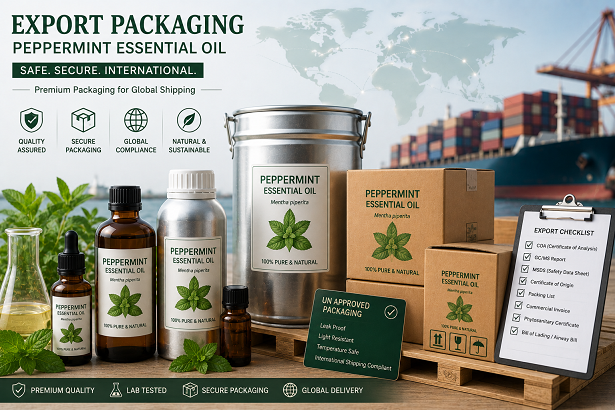
Packaging directly affects product stability during international transportation. Since peppermint oil contains volatile aromatic compounds, it must be protected from heat, light, moisture, and oxidation.
Professional exporters commonly use:
- Amber glass bottles
- Food-grade aluminum bottles
- HDPE containers
- Galvanized Iron (GI) drums
- UN-approved export packaging
Proper labeling should include:
- Botanical name
- Batch number
- Manufacturing date
- Net weight
- Country of origin
- Storage instructions
- Safety warnings
Learn more about safe transportation: International Shipping and Export Packaging Solutions.
How Do Buyers Verify the Authenticity of Peppermint Essential Oil?
Authenticity is one of the most important purchasing criteria in today's international essential oil market. Because peppermint oil is widely used across industries, adulterated or diluted products occasionally enter global supply chains. Professional buyers therefore evaluate suppliers based on transparency, documentation, laboratory reports, and manufacturing practices.
Reliable suppliers typically provide complete batch documentation before shipment. Buyers often compare GC/MS reports, Certificates of Analysis, botanical information, and physical testing parameters to ensure every batch meets agreed specifications.
Indicators of an authentic supplier include:
- Complete batch traceability
- Third-party laboratory testing when requested
- Consistent GC/MS profiles
- Transparent sourcing practices
- Clearly documented manufacturing procedures
- Responsive technical support
- Proper export documentation
Read our related guide: How to Identify Pure and Authentic Essential Oils .
What Certifications Increase Buyer Confidence?
Although certification requirements vary depending on the destination country and customer requirements, internationally recognized certifications significantly improve buyer confidence and simplify procurement decisions.
| Certification | Importance |
|---|---|
| ISO Quality Management | Demonstrates standardized production processes |
| GMP | Ensures hygienic manufacturing practices |
| USDA Organic | Required for certified organic product lines |
| Halal | Supports Middle Eastern and Muslim markets |
| Kosher | Supports specific international food and wellness markets |
| REACH (where applicable) | Supports regulatory compliance in European markets |
These certifications demonstrate that manufacturers follow internationally accepted production and quality management systems.
What Common Mistakes Should Exporters Avoid?
Even manufacturers producing excellent peppermint oil can encounter export challenges if operational processes are not properly managed.
Common mistakes include:
- Incomplete documentation
- Improper packaging materials
- Inconsistent batch quality
- Missing laboratory reports
- Incorrect product labeling
- Poor storage before shipment
- Delayed communication with buyers
- Failure to meet importing country regulations
Avoiding these issues improves customer satisfaction and helps build long-term international partnerships.
Why Is India a Trusted Source for Export-Quality Peppermint Oil?
India has become one of the world's leading producers and exporters of peppermint essential oil because of its favorable climate, experienced cultivators, modern steam distillation facilities, and well-established export infrastructure.
International buyers choose Indian manufacturers because they offer:
- Large-scale production capacity
- Competitive pricing
- Modern laboratory facilities
- Comprehensive export documentation
- Private label manufacturing
- Flexible packaging options
- Reliable global shipping
Related articles:
- Why Businesses Prefer Indian Essential Oil Suppliers for Bulk Orders
- Exporting Essential Oils from India: Complete Guide for Buyers
- What is Peppermint Essential Oil? Benefits and Market Demand
Future Outlook for Peppermint Essential Oil Exports
Global demand for peppermint essential oil continues to increase due to expanding applications in pharmaceuticals, oral care, aromatherapy, cosmetics, food flavoring, wellness products, and natural household formulations. Buyers are becoming more selective, placing greater emphasis on sustainability, traceability, laboratory testing, and supplier transparency.
Manufacturers that invest in modern quality management systems, internationally recognized certifications, and long-term customer relationships are well positioned to benefit from future market growth.
Sources and References
Conclusion
Exporting peppermint essential oil successfully requires much more than producing a premium botanical extract. International buyers expect consistent quality, complete documentation, laboratory verification, safe packaging, regulatory compliance, and dependable logistics. Meeting these expectations helps manufacturers establish trust and develop long-term partnerships in competitive global markets.
Whether supplying pharmaceutical companies, cosmetic manufacturers, wellness brands, or food ingredient distributors, exporters who consistently maintain high manufacturing standards and transparent quality systems will remain preferred sourcing partners for buyers worldwide.
Frequently Asked Questions
1. What is the most important export standard for peppermint essential oil?
Quality consistency supported by GC/MS testing, Certificates of Analysis, GMP manufacturing, and complete export documentation is considered the foundation of international peppermint oil exports.
2. Why do buyers request GC/MS reports?
GC/MS analysis verifies the natural chemical composition of peppermint essential oil and confirms that the product has not been adulterated or diluted.
3. Which documents are commonly required for exporting peppermint oil?
Commercial Invoice, Packing List, Certificate of Analysis, MSDS, Certificate of Origin, GC/MS Report, Bill of Lading, and other destination-specific documents are commonly required.
4. Is USDA Organic certification mandatory?
No. It is required only when buyers specifically request certified organic peppermint essential oil or when selling products as USDA Organic.
5. Why is India a preferred exporter of peppermint essential oil?
India combines abundant raw materials, experienced manufacturers, advanced distillation technology, international quality standards, competitive pricing, and strong export infrastructure.
6. How can buyers select a reliable peppermint oil supplier?
Evaluate manufacturing capabilities, laboratory testing procedures, certifications, export experience, documentation quality, customer support, and supply consistency before placing large orders.
If you want expert help, contact us we will guide you.
About the Author
Premium Essential Oils Editorial Team
The Premium Essential Oils Editorial Team consists of experienced professionals specializing in essential oil manufacturing, botanical extraction, quality assurance, laboratory testing, international trade, and private label production. Our articles are carefully researched to provide practical, trustworthy, and up-to-date information that helps importers, wholesalers, manufacturers, and global brands make informed sourcing decisions while meeting international quality standards.